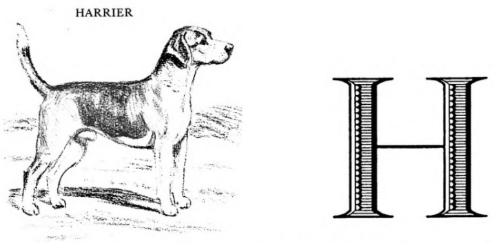
Source: Megargee, E. (1954). The dog dictionary. [1st ed.]. Cleveland, Ohio: World Pub. Co.
We don’t harr much about harriers, vintage or otherwise, so harr’s a post to fix that. (I know the second one was too much. I know it but I did it anyway.)
In The Kennel Club Calendar and Stud Book, Vol. III – 1876, harriers are listed as above or below 18 inches for purposes of show classes. By comparison, the current Kennel Club standard states:
Ideal height: dogs 53 cms (21 ins); bitches 48 cms (19 ins), with a tolerance of 2.5cm (1in) smaller.
Also note the custom at the time of listing only the year of birth for each dog, as opposed to the exact date.
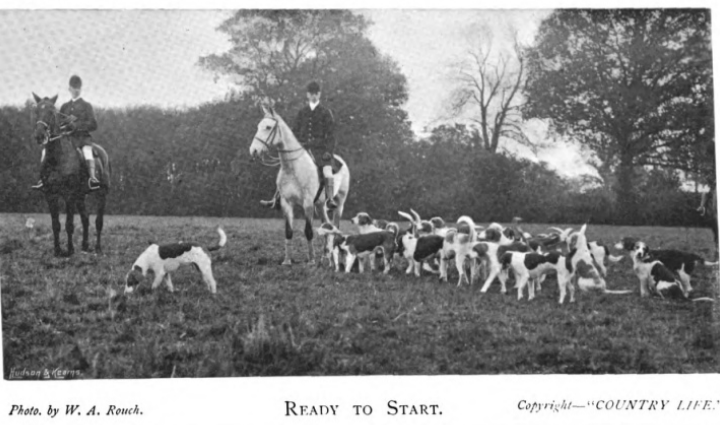
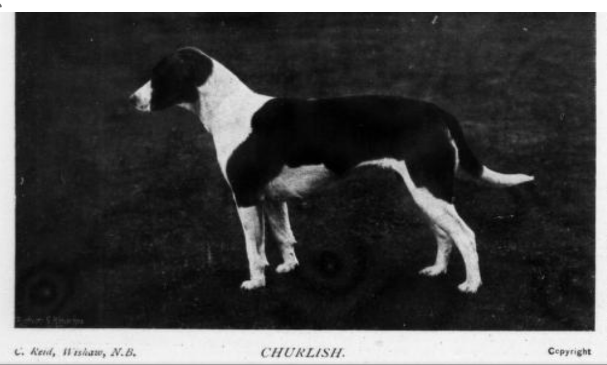
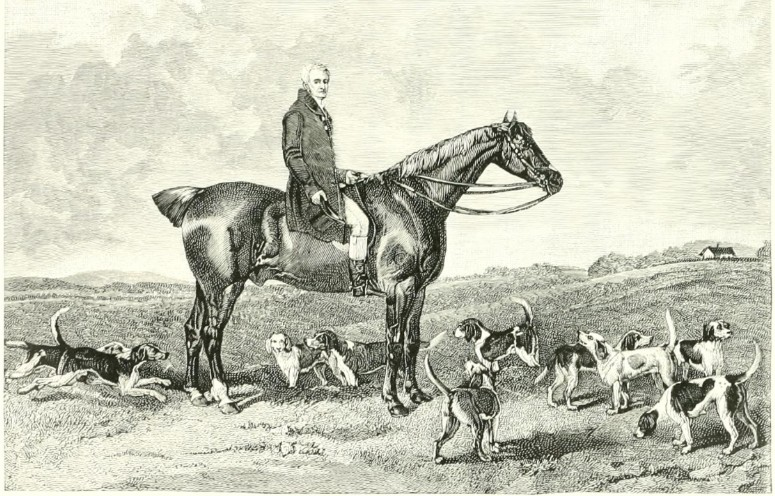
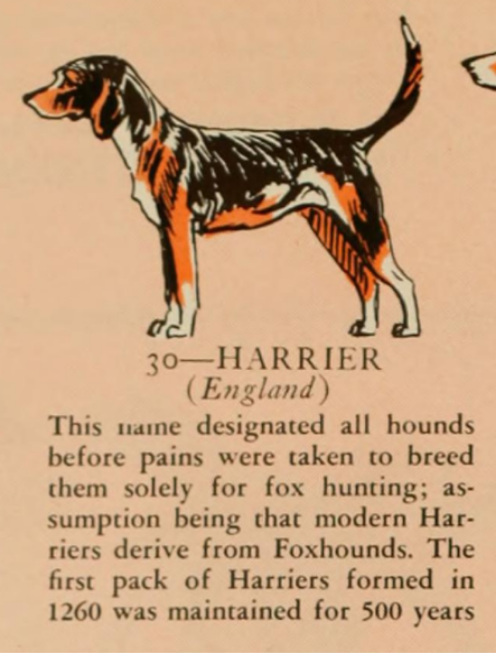
Two images of the Barstable harriers at work, pictured in Country Life Illustrated, February 6, 1897From an article titled The Best of Everything in Country Life Illustrated, February 10, 1900: “This fine harrier, CHURLISH, took the champion prize at the big Peterborough show.” The annual hound show at Peterborough attracted working packs and huntsmen competing for the prestigious wins.Painting by Abraham Cooper, 1836Gilbey, W. (1900). Animal painters of England from the year 1650. London, England: Vinton & CoI guess they couldn’t be bothered finding out the dog’s name. Source: Huntington, H.W. (1901). The show dog. Providence, RI: Remington Printing CoBryden, H.A. (1903). Hare-hunting and harriers. London, England: G. RichardsA pack in the Argentine Republic, drafted from English kennels, pictured in Country Life, December 12, 1903Country Life, April 23, 1904Judy, W. L. (1925). The dog encyclopedia: a complete reference work on dogs. Chicago, Illinois: Judy Publishing Company“The Monmouth County Hunt’s Mr. Reynal’s Monarch, best Harrier doghound” at the New York Hound Show in Country Life and the Sportsman, March 1939Art by Morgan Stinemetz in the guide leaflet: Colbert, E. H. (1953). The origin of the dog. New York, NY: The American Museum of Natural History





 YesBiscuit!